
"Bobang coffee beans"
400 article(s) found

A brief introduction to the origin, development, history and culture of the most classic tin card boutique coffee beans
All the varieties planted in Pu'er area of Yunnan are catimor (Katim). As early as 1950s, typica and bourbon were introduced in Baoshan City, and the locals called them old varieties. Because the old varieties have low disease and pest resistance and yield, and the management is relatively expensive and manpower, coupled with the market purchase price does not have many advantages, brown farmers have changed to new varieties in recent years.

A brief introduction to the description of the flavor, taste and aroma characteristics of the fine coffee bean with slightly fruity flavor.
After inspecting the coffee planting and primary processing base in Yunnan, international coffee organization tasting experts rated Yunnan coffee as the kind of small seed coffee processed by Colombian wet processing, which is the highest quality coffee in the world. Typica and Bourbon, two classic high-quality coffee varieties, are the main coffee varieties in Yunnan, and Katimo was introduced from Kenya in 1991.
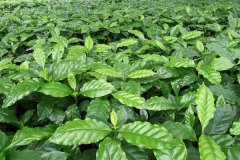
How does Yunnan small grain coffee taste? how many flavors does Yunnan small grain coffee have?
Professional coffee knowledge exchange more coffee bean information please follow the coffee workshop (Wechat official account cafe_style) Yunnan coffee cultivation and output accounts for 98% of the country, Yunnan coffee in the end what is good? Yunnan is the main coffee producing place in China, and more than 90% of the coffee in China is produced here. Baoshan, Lincang, Pu'er and Dehong are the main coffee producing areas in our province.

A brief introduction to the description of the flavor, taste and aroma characteristics of Hongding coffee iron card boutique coffee beans
The average temperature of Lujiangba in Baoshan is 21.5℃, and the highest is 40.4 ℃, which is basically frost-free all the year round. It is recognized as the best producing area of small-grain coffee. The small-grain coffee cultivated here is famous at home and abroad for its strong but not bitter, fragrant but not strong, well-proportioned small noodles, mellow and fruity. International Coffee Organization tasting experts evaluated Yunnan coffee after inspecting Yunnan coffee planting and primary processing bases.

A brief introduction to the Origin, Development, History and Culture of Iron Card Fine Coffee beans with strong aroma
Small grain coffee is suitable for growing in the mountains at an altitude of 8001800 meters. If the altitude is too high, it will taste sour, and if it is too low, it will taste bitter. Small grains of coffee are mostly planted in dry and hot valleys about 1100 meters above sea level, so they are moderately sour, rich and mellow. There is a unique environment suitable for the growth of small seed coffee in many areas of Yunnan, and the quality of small seed coffee is excellent. The planting area is mainly distributed in the

A brief introduction to the planting situation, geographical location, climate and altitude of red-top coffee iron card fine coffee beans
Yunnan small grain coffee is a 34-year-old fruiting tree. Coffee is a short-day plant. Coffee has the characteristics of multiple flowering and concentrated florescence. The florescence of small seed coffee in Yunnan is 27 months, and the flowering period is 35 months. The flowering of coffee is greatly affected by climate, especially rainfall and temperature. Coffee flowers have a short life span of only 23 days. Small seed coffee usually opens at 35: 00 in the morning and blooms at 57: 00
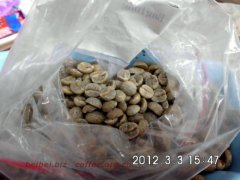
Pictures of coffee beans Nepal Baglung Balon Baglong
Picture of coffee beans Nepal Baglung Balon Baglong, coffee beans in the shape of a shorter garden, a little Bobang feeling. Nepalese Baglung Balon Baglong coffee beans are handled quite cleanly. Coffee producing Nepal is located in the Himalayas, pollution-free, chemical-free land, creating a natural and pure coffee. Nepal, located at the southern foot of the Himalayas, is 800-1600 meters above sea level.

A brief introduction to the treatment method of grinding degree and baking degree of tin card fine coffee beans with excellent performance
Tibica coffee, native to Ethiopia and southeastern Sudan, is the most widely cultivated variety of coffee in the Western Hemisphere. The plant is stronger, but not light-tolerant, and the yield is higher in Hawaii. The top leaf of Tibika is red and copper, which is called red top coffee. Bourbon coffee is a variety of small-grain coffee second only to Tibica. At first, the main branch and the trunk grew upward at 45 degrees, drooping with the fruit load, and lateral branches.

A brief introduction to the treatment method of Grinding degree and Baking degree of Yunnan Katim Fine Coffee beans
Catimor: Katim is not pure Arabica blood, it is a hybrid of Timor (which belongs to Robusta) and caturra (a variety of Bobang), so catimor has 25% Robusta blood, and its Robusta blood also determines its taste defects: the aroma is not rich enough, and the overall taste is bitter, and it is prone to astringency and irritation.

A brief introduction to the Origin, Development, History and Culture of Red Top Coffee and Iron Card Fine Coffee beans
Small grain coffee is suitable for growing in the mountains at an altitude of 8001800 meters. If the altitude is too high, it will taste sour, and if it is too low, it will taste bitter. Small grains of coffee are mostly planted in dry and hot valleys about 1100 meters above sea level, so they are moderately sour, rich and mellow. There is a unique environment suitable for the growth of small seed coffee in many areas of Yunnan, and the quality of small seed coffee is excellent. The planting area is mainly distributed in the

Introduction to the taste and flavor of Yunnan Tieka boutique coffee beans
During the Tang Dynasty, GE Luofeng, the king of Nanzhao, was sent to Chang'an to worship the king of the Tang Dynasty. Wang asked: where is the king? The remote guide said: under the clouds in the south. So in the eyes of the imperial court, Yunnan was the name of the southwest frontier of the people's motherland. In the sixteenth year of the Yuan Dynasty (728), the king of the Tang Dynasty sealed the cabinet Luofeng as the king of Yunnan. Yunnan Xingzhong Shu province was established from Yuan to Yuan 11 (1274), and Yunnan was officially determined as the name of the Yunnan region.

Famous Coffee Raw beans introduce Yunnan small Coffee
The western and southern parts of Yunnan small grain coffee Bourbon Bobang AA Yunnan Province are located between 15 N and the Tropic of Cancer, most areas are 1000-2000 meters above sea level, and the topography is mainly mountainous and sloping, with large ups and downs, fertile soil, sufficient sunshine, rich rainfall and large temperature difference between day and night. These unique natural conditions form the particularity of Yunnan small grain coffee taste.

Why "Arabica beans" is higher than "Robasta beans"?
Following Cafe (official Wechat account vdailycom) found that there are two main types of coffee trees: coffea arabica and coffea robusta/coffea canephora (rare on the market). Arabica (Coffea arabica) is the most traditional Arabica coffee variety. Originated in the east

Species of small Coffee beans in Yunnan
Typica and Bourbon, two classic high-quality coffee varieties, are the main coffee varieties in Yunnan. In 1991, Katimo Catimor series varieties were introduced from Kenya (with stronger anti-virus ability and higher yield). A variety of Arabian species (also known as small seed species). Because the morphology and habits of the two varieties are similar, the two varieties are mostly mixed. Iron

Introduction to the characteristics of Yunnan Coffee varieties whether Yunnan small-grain coffee beans are kadim or iron pickup
Typica and Bourbon, two classic high-quality coffee varieties, are the main coffee varieties in Yunnan. In 1991, Katimo Catimor series varieties were introduced from Kenya (with stronger anti-virus ability and higher yield). Arabian species (also known as small grain species)

What kind of coffee does Katim coffee grow in Yunnan, China?
Catimor is not a pure Arabica pedigree, it is a hybrid of Timor and bourbon, it lacks rich aroma and flavor, and has a shallow smell of grass and soil, but its advantages are pest resistance, easy management and production.

A brief introduction to the cultivation of high-yield high-quality coffee beans in Yunnan, geographical location, climate and altitude
However, it does not mean that you have not had a cup of good Yunnan coffee, and if the post-processing and baking is good, as a friend said here, the coffee from several hills, such as Pu'er Manlaojiang, Kaddura of Manzhong Tian, Tielka of Baihualing of Lujiang, Baoshan, and Bourbon of Lujiang, Baoshan, is still good, especially resistant. The old varieties of Yunnan coffee at 1800m above sea level are currently supplied to the domestic market by 30%, 70%.

Arabica coffee (what is Arabica?) What are Arabica coffee beans?
There are various Coffea species, but the two most common are Coffea Arabica and Coffea Canephora, commonly known as Arabica and Robusta. Arabica grows in the tropical and equatorial strips of America, Africa and Asia and it is the most de

Yunnan small Coffee introduce Iron pickup Coffee Flavor and Taste introduce Fine Coffee beans
Catimor: Katim is not pure Arabica blood, it is a hybrid of Timor (which belongs to Robusta) and caturra (a variety of Bobang), so catimor has 25% Robusta blood, and its Robusta blood also determines its taste defects: the aroma is not rich enough, and the overall taste is bitter, and it is prone to astringency and irritation.
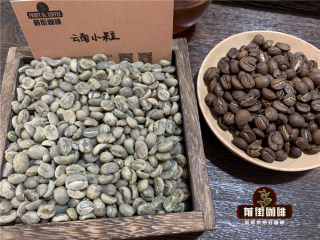
Yunnan coffee cultivation natural conditions Yunnan coffee production area Pu 'er coffee varieties characteristics
Professional coffee knowledge exchange More coffee bean information Please pay attention to coffee workshop (Weixin Official Accounts cafe_style) Qianjie Yunnan coffee production area introduction Yunnan is located in the world coffee planting golden belt, good ecological environment, rich natural resources create Yunnan coffee characteristics. Coffea yunnanensis